Table Of Content
h1, h2
DreamInfluence pricing in 2026: tiers, onboarding fees, contracts, reviews, and the best alternatives — plus when a full-service agency beats running software yourself.


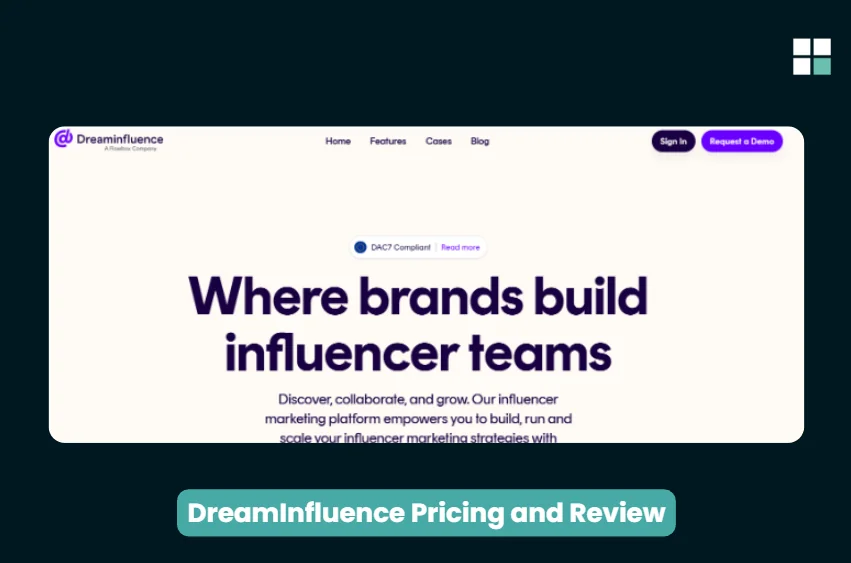
Table Of Content
DreamInfluence pricing isn't published as a clean public table, but the tiers reported across review sites are consistent: plans run from roughly €675/month up to €2,000/month, all billed annually, each with a one-time onboarding fee on top. There's no free trial and no monthly option.
It's a Nordic-built platform (now part of Flowbox) with a curated network of 25,000+ verified creators, leaning toward ecommerce and content collection. The catch is the commitment — a mandatory 12-month contract with a 3-month cancellation notice.
If you're weighing DreamInfluence, it's worth knowing there's a different route entirely: instead of buying software and running campaigns yourself, you can have a full-service agency handle the whole thing. More on that below — but first, the numbers.
DreamInfluence doesn't publish a simple public pricing table, but the tiers reported across review sites are consistent. Every plan is billed annually and adds a one-time onboarding fee on top of the monthly rate.
The entry plan for brands starting a structured influencer program. It covers core discovery, campaign management, and a capped number of influencers. The main constraint is volume — it's built for smaller programs, and you'll outgrow the influencer limit as you scale.
Aimed at brands running campaigns more consistently, with a higher influencer allowance and more advanced features unlocked. The jump in onboarding fee (nearly double Basic) is worth noting when you budget year one.
Built for larger programs managing more creators at once, with the fuller feature set and higher quotas. At this tier you're competing directly with platforms like GRIN and Upfluence on price, so the curated-network advantage needs to carry its weight.
Quote-based for high-volume brands and agencies needing custom limits and support. As with most custom tiers, clarify exact creator caps and what's gated before signing.
For context on where this lands versus other ecommerce-focused tools, it helps to compare it against the broader set of storefront software options before committing.
Watch for these hidden costs. The onboarding fees (€670–€2,700 depending on tier), the mandatory 12-month commitment with no monthly option, and VAT for Danish companies. Charges can also be billed in USD, so factor in currency fluctuation if you're budgeting in another currency.
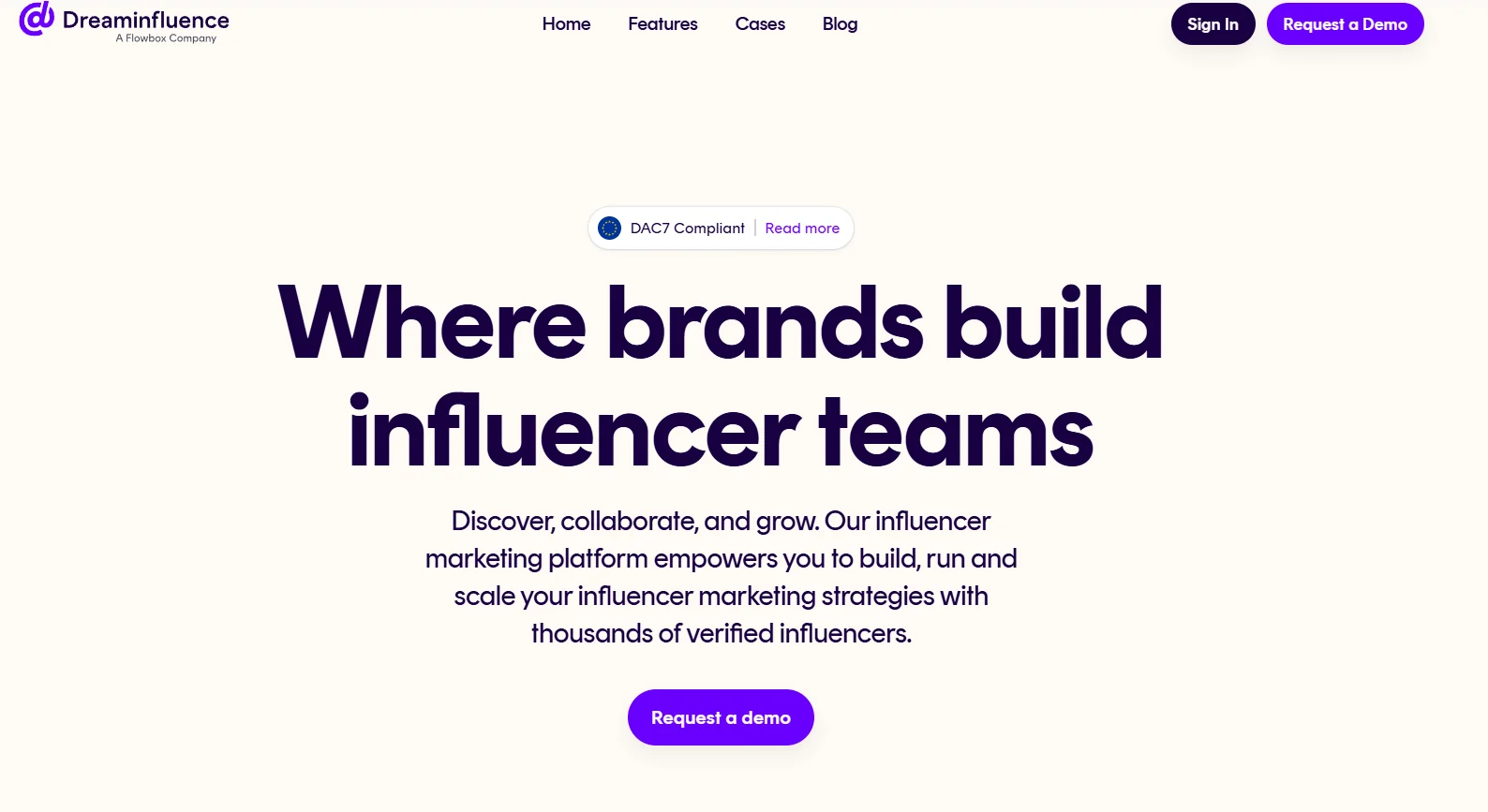
DreamInfluence is an all-in-one influencer marketing platform built around a curated, vetted creator network rather than a massive open database. It started in Denmark, was acquired by UGC platform Flowbox, and is positioned for brands and agencies that want a managed roster of verified creators plus the tools to run campaigns end to end — discovery, content collection, payments, and reporting in one place.
• Curated creator network — Access to 25,000+ hand-picked, verified influencers, weighted toward Nordic and European markets. The pitch is quality over quantity: a vetted roster instead of millions of unscreened profiles you have to filter yourself.
• Campaign management — Plan, launch, and track campaigns from a single dashboard, with content statuses and reminders so you can see who's posted and who's pending. It replaces the spreadsheet shuffle most in-house teams default to.
• Content library — Collect, review, and download influencer-created content with one click, then reuse it across channels. Useful for brands that want a steady stream of UGC for organic and paid placements.
• Wallet and payments — Handle campaign spend, invoicing, and creator payouts inside the platform rather than chasing invoices manually. Payments and budgeting live in the same view as performance.
• Analytics and discovery — Track engagement, clicks, reach, and views, with built-in discovery tools to match creators to your brand. There's also a Shopify app that tracks influencer-driven discount codes and sales.
DreamInfluence holds a 3.4 out of 5 on Trustpilot across 81 reviews. The split is sharp — most reviews are 5-star, but a cluster of recent low ratings drags the average down, and that's where the useful signal is.
Praise tends to land on the same things: helpful, friendly staff and a genuinely effective way to connect brands with vetted creators. One Danish ecommerce brand reported scaling from one country to five and from 40 to 400 creators within months of onboarding.
The criticism is more pointed. Multiple reviewers call it expensive for what it delivers — one flatly described it as "pricey for what it does" — and flag the rigid contracts, the onboarding fee, and the auto-renewing 12-month term with a 3-month cancellation notice. A recurring theme: brands still had to do significant manual outreach and planning themselves, which is exactly the work they expected the platform to handle.
Here's the real decision, and it isn't tool vs. tool. DreamInfluence gives you the infrastructure to run influencer campaigns in-house; NC Media runs them for you and is accountable for the results. One is software you operate, the other is a team that operates on your behalf.
A quick contrast of the two models:
• Model — DreamInfluence is a SaaS tool where you manage campaigns; NC Media is a full-service agency that manages everything.
• Pricing — DreamInfluence is ~€675–€2,000/month plus onboarding (software only); NC Media is scoped to your brand's needs and goals.
• What's included — DreamInfluence gives you discovery, a creator CRM, content collection, and reporting tools; NC Media delivers strategy, outreach, execution, UGC, and reporting as a service.
• In-house effort — DreamInfluence still requires your team to run outreach, briefs, approvals, and tracking; with NC Media, that operational lift sits with the agency.
When the software wins. If you have a dedicated in-house influencer marketing hire and the bandwidth to run campaigns yourself, a platform like DreamInfluence is a reasonable call — especially if your audience skews Nordic or European, where its curated network is strongest. You're paying for tooling and a vetted roster, and you supply the labor.
When NC Media wins. Brands without a dedicated influencer resource, or those that bought software and found the day-to-day lift too heavy, get more from a done-for-you model. NC Media brings 8 years of experience, 50K+ influencer partnerships, and 120K+ UGC assets produced, with an average 8X+ ROAS increase and -52% CAC reduction across clients like Lululemon, Decathlon, Nespresso, and Under Armour.
The hidden cost of software. The subscription is never the full cost. Someone still has to do the outreach, write the briefs, approve content, manage payouts, and compile reports — and DreamInfluence reviewers specifically flagged that they spent nearly the same hours on planning and communication as they would have without it. Once you price that internal time, the gap between a software fee plus onboarding and an agency retainer narrows fast.
For the right brand, yes. If you operate in the Nordics or wider Europe, value a vetted creator roster over a giant open database, and have someone in-house to actually run campaigns, DreamInfluence does what it says — and the content library and in-platform payments are genuinely convenient. The scaling stories from happy customers are real.
Where it falls short is flexibility and lift. The 12-month lock-in, onboarding fees, and no-trial policy put all the risk on you before you've proven fit, and the platform still expects meaningful manual work from your team. If you're running a serious ecommerce program and want sales tied directly to creators, you may find a stronger fit among tools purpose-built for creator commerce — or you may decide you'd rather not manage a tool at all.
If DreamInfluence's pricing, contract terms, or feature set aren't the right fit, these three cover similar ground for brands that have decided software (not an agency) is their route.
• All-in-one platform for brands and agencies covering discovery, outreach, CRM, gifting, UGC, affiliate, and payments in one place.
• Pricing: Standard $649/month, Pro $1,049/month, Business $2,490/month, with a 3-month minimum (far shorter than DreamInfluence's 12).
• The strongest all-rounder here: a 250M+ creator database and AI-personalized outreach mean you're not limited to a curated roster, and the full workflow lives in one plan.
Influencer Hero packs the entire campaign lifecycle — from finding creators to paying them — into a single dashboard, with native Shopify, WooCommerce, and Magento integrations for real sales attribution. For brands that found DreamInfluence's network too narrow or its contract too rigid, it offers more reach and more flexible terms per dollar.
• Discovery-first platform with a massive creator database, strong audience analytics, and a clean, easy-to-learn interface.
• Pricing: Essential $199/month, Performance $499/month (adds Shopify), Enterprise custom — all billed annually.
• A credible pick if DreamInfluence's curated network feels limiting; Modash trades a vetted roster for sheer discovery depth at a lower entry price.
Modash is the budget-friendly, search-heavy option, especially for teams that prioritize finding new creators over an all-in-one workflow. If discovery is your bottleneck, it's worth reviewing the full set of Modash alternatives to see where it sits against the rest of the field.
• Marketplace-driven platform built for always-on UGC, ambassador, and creator-commerce programs at scale.
• Pricing: tiered plans typically starting around $2,000/month on annual agreements.
• A strong DreamInfluence alternative for content-heavy ecommerce brands, with a 1M+ creator marketplace where influencers apply to your campaigns directly.
Aspire suits brands running constant seeding and UGC programs that want inbound creator applications alongside outbound outreach. It overlaps closely with DreamInfluence's content-collection strengths, with a bigger marketplace behind it.
And if managing any of these tools yourself sounds like more than you want to take on, that's exactly where a full-service agency comes in — more on that just below.
DreamInfluence is a capable, content-focused platform with a vetted European creator network and a tidy all-in-one workflow. But the real cost is more than the ~€675–€2,000/month sticker: add onboarding fees, a 12-month lock-in, and the internal hours your team still spends on outreach and reporting, and the math gets heavier than it first looks.
That's the question worth sitting with — not "which tool," but "do I want to run this in-house at all?" For brands that want influencer marketing to function as a measurable growth channel without building and staffing an in-house operation, a full-service agency delivers the outcomes without the operational lift or the contract risk.
If you're evaluating DreamInfluence and wondering whether a full-service agency might be a better fit, NC Media offers a no-commitment consultation. Book a call here.
FAQ






.png)