Table Of Content
h1, h2
Tolt pricing runs $69 to $199 a month with no commission on affiliate revenue — here's what that actually costs once payout fees and revenue bands are factored in, and the one thing Tolt doesn't do at any price.


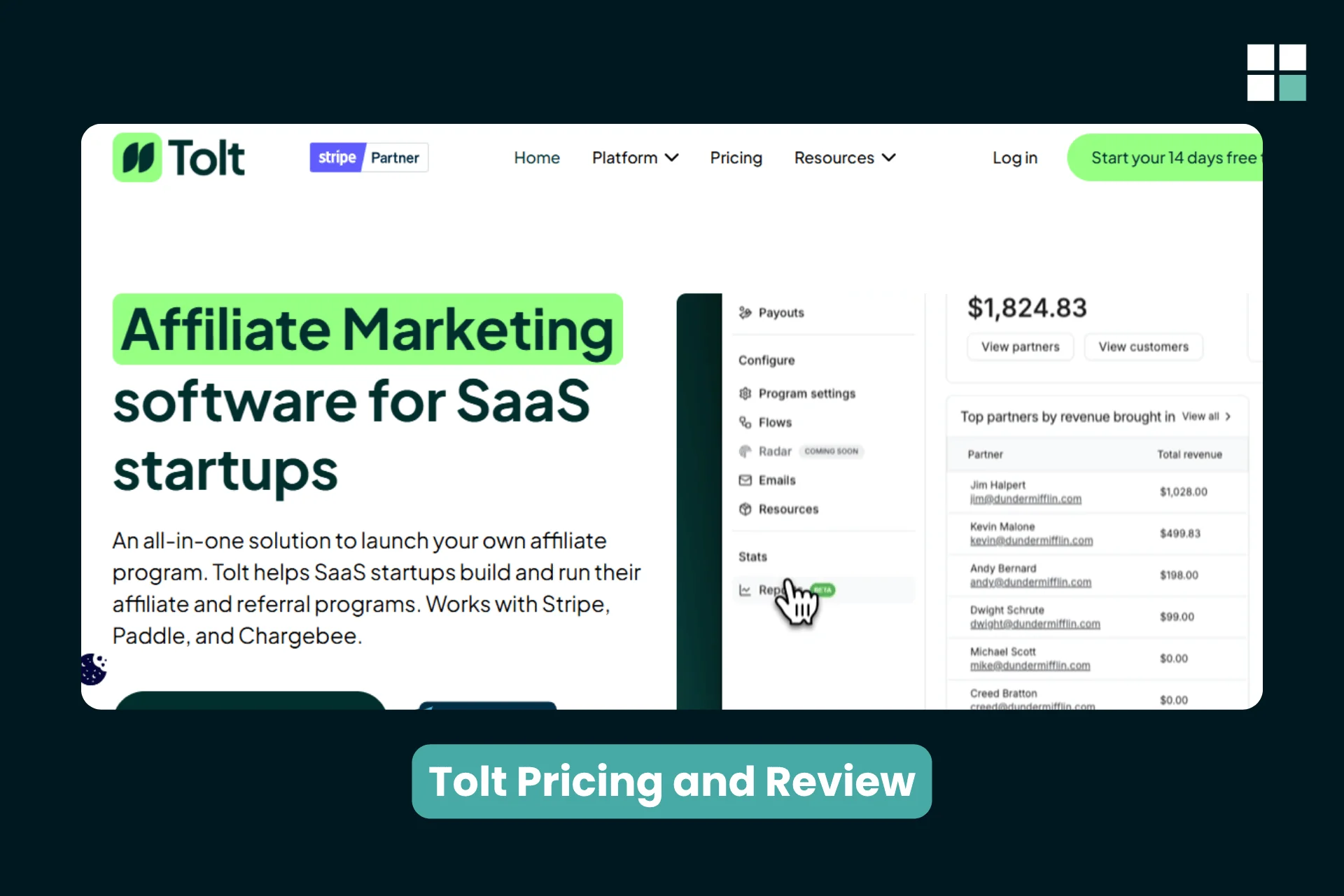
Table Of Content
Tolt pricing is $69/month (Basic), $99/month (Growth) and $199/month (Pro), with a quote-based Enterprise tier above $50,000/month in affiliate revenue. Every plan includes a 14-day free trial with no card required.
The tiers aren't gated by seats or features in the usual way. They're banded by how much revenue your affiliates generate — cross a threshold and you move up, whether or not you need anything the next tier adds.
Tolt's headline pitch is 0% commission versus competitors charging from 9%. That's largely true and it's a real advantage. It's also not the whole cost, and the gap between sticker and all-in is worth understanding before you pick a tier.
The entry tier covers most early-stage programs. The two things missing matter though: there's no auto payouts, so you're paying affiliates by hand through PayPal or Wise, and your portal still carries a "powered by Tolt" link.
This is the tier where the admin burden actually lifts. Tax form collection and 1099 filing alone justify the $30 jump for any US-based program with more than a handful of affiliates. A reviewer on Capterra specifically flagged auto-payouts being locked behind this tier as their main complaint.
The white-label removal only lands here. Basic and Growth both advertise a "branded portal with custom domain" and still carry Tolt's badge, which is a slightly awkward gap between the marketing and the feature list.
Everything in Pro plus priority support, for programs clearing $50,000/month in affiliate revenue.
Because tiers are banded by affiliate revenue, the useful number isn't the sticker — it's what you're paying per dollar your affiliates generate.
Against a competitor charging 9% of affiliate revenue, that's not close. At $50,000/month in affiliate revenue, a 9% model costs $4,500 and Tolt Pro costs $199 — a difference of over $4,300 a month.
The 2% that isn't 0%. Auto payouts on Growth and up carry a 2% processing fee. Assume a 30% commission rate, so $20,000 in affiliate revenue means $6,000 in payouts and $120 in fees. All-in cost goes from $99 to $219, and the effective rate roughly doubles from 0.50% to 1.09%.
Still dramatically cheaper than a 9% model. But "0% commission" describes the revenue share, not the total, and if you're modelling this against alternatives you should be comparing all-in numbers.
The band cliff. Crossing a threshold by a single dollar triggers the full jump. Going from $20,000 to $20,001 in affiliate revenue moves you from Growth to Pro — your software bill doubles from $99 to $199 for one extra dollar earned. Worth knowing if you're sitting just under a ceiling.
On the Rewardful comparison. Tolt's own alternatives page pitches getting Rewardful's features for 50% less. Per publicly listed pricing, Rewardful's entry plan is $49/month covering up to $7,500/month in affiliate revenue, versus Tolt's $69 covering $10,000. That's 41% more on sticker and a near-identical 0.65% vs 0.69% per covered dollar. Tolt covers more revenue for the money, but the 50%-less claim doesn't hold at the entry tier.
If you've seen other numbers, they're stale. Capterra currently lists Basic at $49 and shows an "Unlimited" tier at $299 that doesn't exist on Tolt's site. SaaSworthy lists Tolt as starting at $20 with a free-forever plan — there is no free plan, only a 14-day trial.
Tolt's own pricing page is the only reliable source. There's also a 30-day no-questions-asked refund policy, which isn't mentioned in most third-party listings.
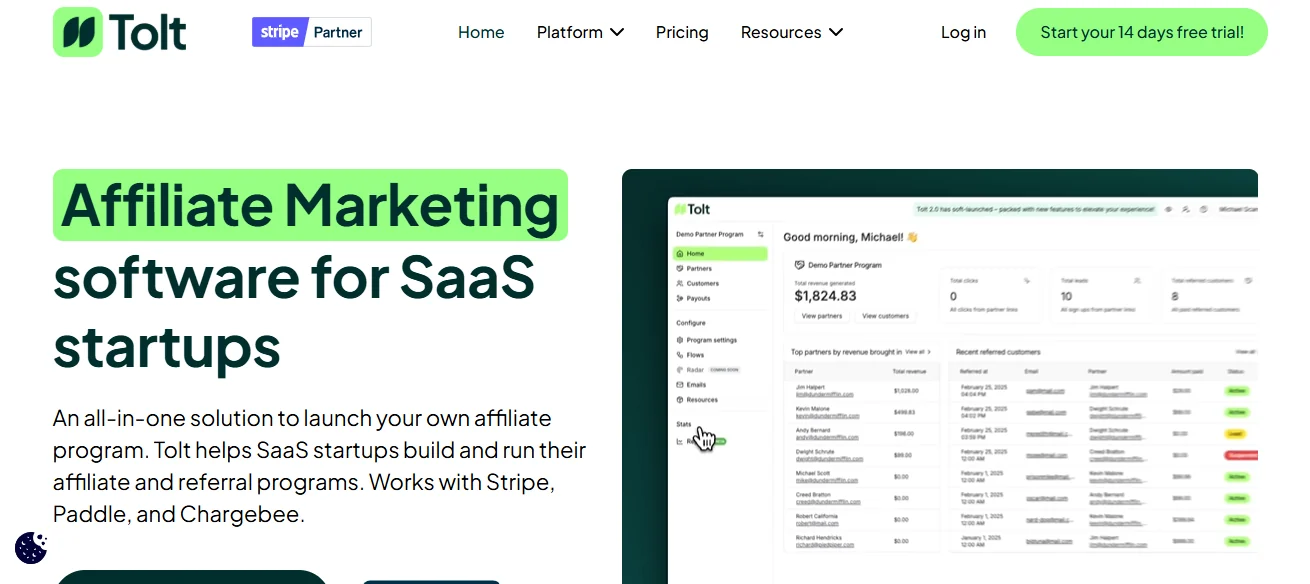
Tolt is affiliate marketing software built specifically for SaaS startups running on subscription billing. It handles tracking, commission calculation, a branded affiliate portal and payouts — the plumbing of an affiliate program rather than the growth side of it. It's a Stripe partner, positions itself against Rewardful, FirstPromoter, Tapfiliate and PartnerStack, and its customer base skews heavily to founders and small teams.
Tolt holds a 5.0 on Capterra across 19 reviews — every single one rated five stars, with nothing at four or below.
That distribution deserves a caveat, and it's a significant one: all 19 reviews carry Capterra's "Vendor Referred — Incentive Offered" disclosure. Every reviewer was invited by Tolt and given a nominal incentive. The feedback reads as genuine and specific, but a perfect score from an entirely vendor-solicited sample isn't the same signal as a perfect score from organic reviews.
What's useful is the criticism that surfaced anyway. A partnerships manager who moved from PartnerStack praised the ease of transition and the price but noted the "lack of reporting and insights was something we miss." Others flagged no link-level performance data and auto-payouts being gated to the $99 tier.
The sharpest operational note came from an e-learning CEO: commissions are calculated on gross revenue rather than net of Paddle processing fees, meaning "our effective commission rate is quite a bit higher than what we show to affiliates." If you're modelling program economics tightly, that's a real gap.
One more thing worth checking before you buy: Tolt's own pages disagree on integrations. The homepage advertises two-way sync with Stripe, Paddle and Chargebee; the FAQ on the pricing page says you can only integrate if you're on Stripe or Paddle; and its Capterra profile claims Stripe, Paddle and Shopify Partners while the same FAQ lists Shopify as still in development. Confirm your billing stack directly with them.
Being direct: if you're a SaaS company on Stripe or Paddle looking for affiliate tracking, NC Media isn't your answer and Tolt probably is. These products don't compete.
The comparison is worth making for one reason. Tolt tracks and pays affiliates — it doesn't find them. There's no discovery, no marketplace, no recruitment. One reviewer named this directly, noting Tolt doesn't offer an affiliate discovery portal. Whoever promotes your product, you sourced yourself.
When Tolt wins. SaaS on subscription billing with an existing audience to convert into affiliates — customers, community, newsletter list. At under $200/month with no revenue share, the economics are hard to argue with, and setup genuinely takes under an hour by multiple accounts.
When NC Media wins. For consumer and D2C brands, Tolt isn't a partial fit — it's the wrong stack entirely, since it runs on Stripe and Paddle rather than Shopify or WooCommerce. If you landed here researching affiliate software for an e-commerce brand, the useful information is that this one won't connect to your store.
What those brands usually need isn't tracking software anyway. It's the creators. NC Media has spent eight years sourcing, negotiating and running creator programs for brands including Lululemon, Arsenal, Decathlon, TCL, Nespresso and Under Armour — with an average 8X+ ROAS increase and -52% CAC reduction.
The recruitment gap. This applies to SaaS teams too. Tolt gives you a perfect system for paying affiliates and no help getting any. Plenty of programs launch, sit at three signups, and quietly die — not because the software failed, but because nobody owned the outreach. Whichever tier you pick, budget the time or the partner to actually fill it.
For SaaS startups on Stripe or Paddle, yes, and the value is obvious. Sub-$200/month with no revenue share, unlimited affiliates, tax handling from the Growth tier and a 30-day refund policy is a low-risk way to stand up a program — and the customer support comes up in nearly every review as genuinely fast.
Where it falls short is reporting depth and reach. Multiple users moving from PartnerStack flagged thinner analytics, there's no link-level performance data yet, and the platform only works with two billing providers. If you need e-commerce integration, partner discovery, or reporting your board will accept, this isn't there yet — the team says more is coming, but buy on what exists.
If Tolt's billing integrations or feature depth don't fit, these three cover adjacent ground.
This is a step up in both price and scope, and it's the right comparison only if your problem is finding partners rather than paying them. Discovery, outreach, CRM, gifting, UGC capture, affiliate tracking and payments sit in one plan, and it connects to Shopify rather than Stripe-only billing. For a SaaS founder who just needs tracking, it's overkill — for an e-commerce brand, it's the category Tolt can't serve.
If your affiliate revenue is under $7,500/month, Rewardful's Starter is the cheaper sticker. G2 shows it with more reviews and a 4.4 rating across a broader organic sample, which is a different kind of evidence than Tolt's incentivized 5.0. Worth running both trials.
The pick if you sell both subscriptions and physical products, or if the revenue-band cliff bothers you. It integrates with Stripe, Shopify, WooCommerce and 30-plus other tools. The trade-offs are click and conversion caps with overage fees, and a single seat on the entry plan.
And if managing any of these yourself sounds like more than you want to take on, that's exactly where a full-service agency comes in — more on that below.
Tolt is well-priced, well-supported software that does a specific job properly. At $69 to $199 a month with no revenue share, it's among the cheaper ways to run a SaaS affiliate program, and the honest caveats are modest: a 2% payout fee that makes "0%" less absolute, revenue bands that jump hard at the edges, thinner reporting than enterprise tools, and a five-star rating built entirely from vendor-invited reviews.
What it doesn't do — at any tier — is find you partners. If your bottleneck is creators rather than tracking, or if you're a consumer brand where Tolt won't connect to your store at all, that's a different problem. NC Media handles the sourcing, negotiation, content and reporting side, with performance measured in ROAS and CAC.
If you're evaluating Tolt and wondering whether a full-service agency might be a better fit, NC Media offers a no-commitment consultation. Book a call here.
FAQ









.png)