Table Of Content
h1, h2
GRIN pricing 2026: self-serve plans from $399–$1,799/month, enterprise contracts $30K–$50K+/year. See the full breakdown — and the agency alternative.


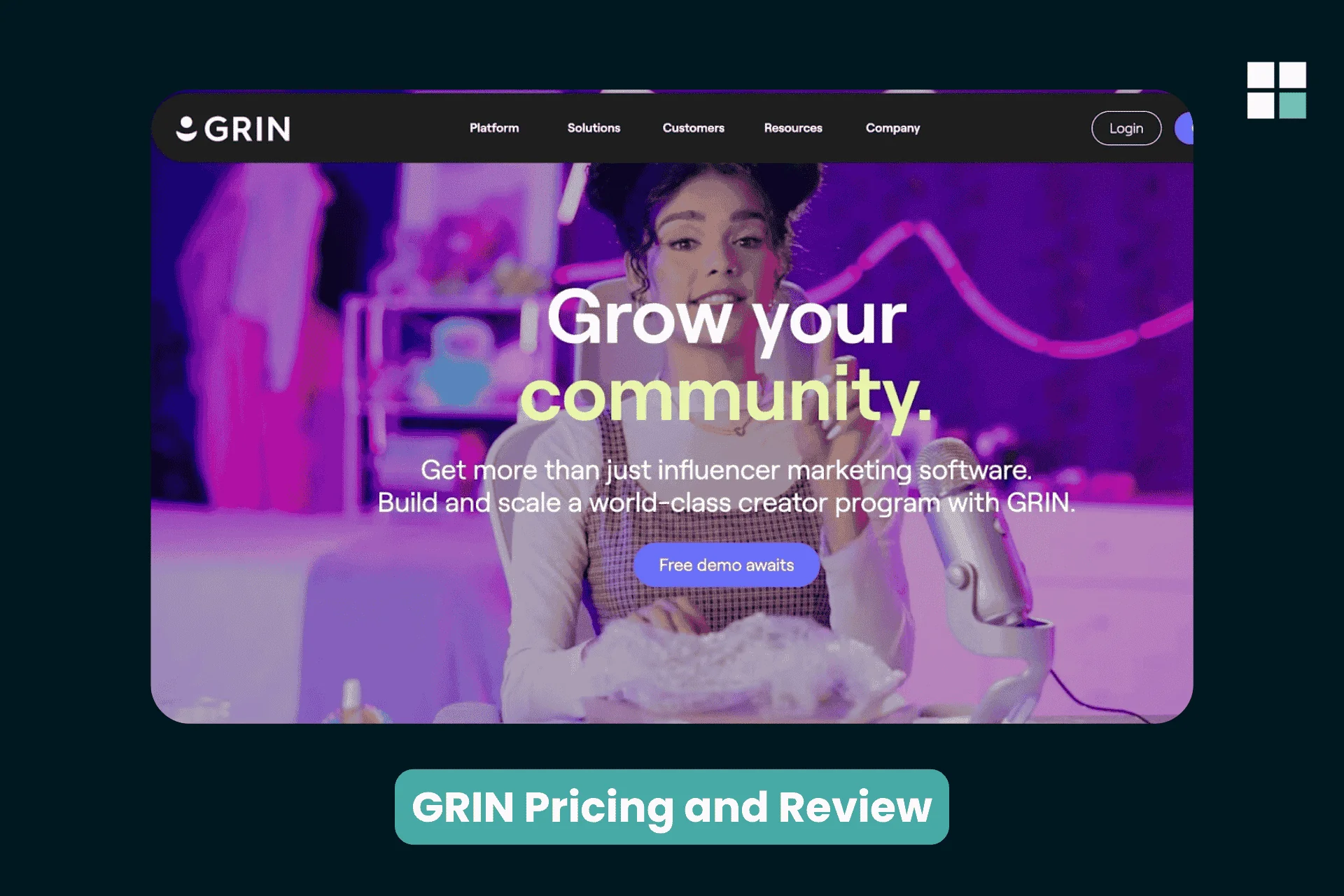
Table Of Content
GRIN pricing now runs on two parallel models. The newer self-serve tiers are publicly listed — Lite at $399/month, Essentials at $699/month, Growth at $1,149/month, and Complete at $1,799/month, with month-to-month billing and a 30-day free trial.
But GRIN also still operates an enterprise sales-led model with 12-month contracts, auto-renewal, and Vendr data showing starter deployments at $30,000–$50,000 annually. Which model you get depends on how you enter the buying process — and the difference matters more than it should.
This guide breaks down what GRIN actually costs in 2026, what each pricing path includes, where the platform genuinely delivers, and the well-documented friction users report. If you're evaluating it, it's also worth knowing there's a done-for-you alternative worth considering — more on that below.
GRIN has shifted toward transparent self-serve pricing for SMB buyers while keeping enterprise sales-led contracts for mid-market and larger deployments. The two paths look very different. Here's the published self-serve structure:
A 30-day free trial is offered on the self-serve plans, typically without requiring a credit card. Enterprise contracts are annual with auto-renewal.
The entry tier. Useful for very small brands testing the channel, though feature access is restricted and creator capacity is low.
This is where GRIN's payment automation kicks in — the 1099 processing alone can be a real time-saver for U.S. brands paying creators.
The Growth tier is where most serious DTC brands actually land. The affiliate features integrate with Shopify and other e-commerce platforms — this is GRIN's strongest territory.
The top self-serve tier, competitive with mid-market custom-quote alternatives like CreatorIQ and Aspire. The API access and creator capacity make it suitable for brands running large programs.
The enterprise model is sold through GRIN's sales team and runs on annual contracts. Multiple recent reviews (Capterra, Trustpilot, G2, Shopify App Store) flag the contract and auto-renewal terms as the single biggest friction point with GRIN — more on this below.
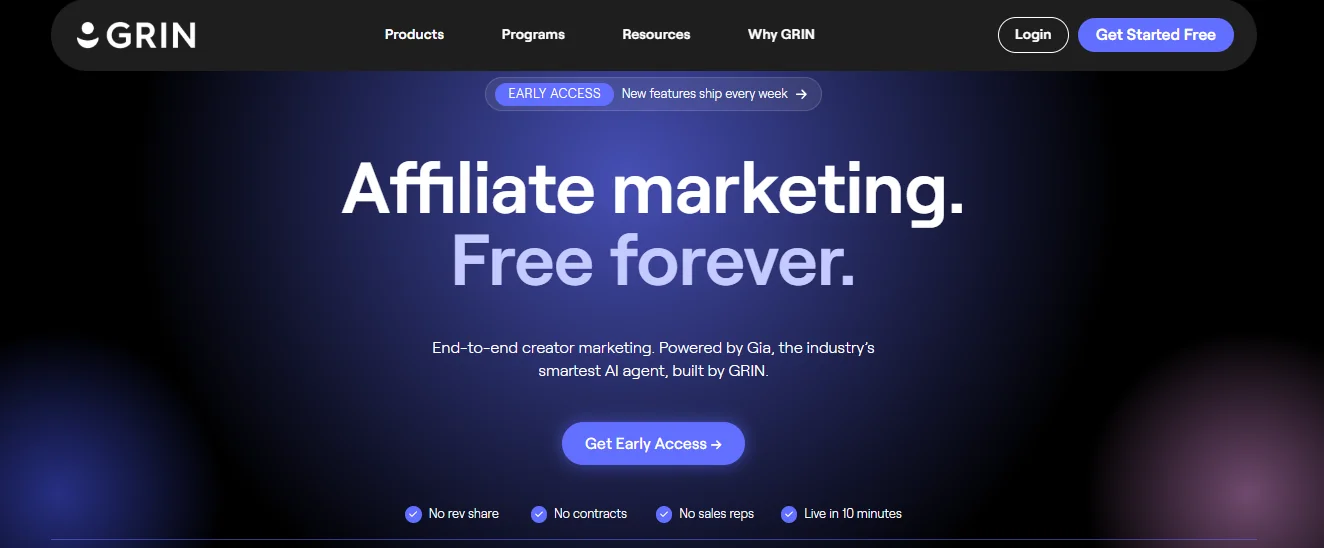
GRIN positions itself as "the only creator management platform built for e-commerce." Founded with a clear DTC/Shopify focus, the platform integrates deeply with Shopify, BigCommerce, Magento, WooCommerce, and Amazon for product seeding, discount code generation, affiliate tracking, and real-time sales attribution.
The platform combines creator discovery, outreach, relationship management, campaign tracking, content management, and payments in a single system — and is genuinely strong in that DTC-and-e-commerce lane. Its 2026 product roadmap added AI-powered creator matching, automated gifting follow-ups, improved fraud detection, and tighter integration with TikTok Shop and Instagram Shopping. GRIN is trusted by a long list of DTC brands and consistently rates strongly on G2 for ease of use.
GRIN is highly rated (4.6/5 on G2) and users frequently praise its Shopify integration, payment automation, campaign management, and customer support. However, negative reviews consistently center on two areas: contract terms and feature delivery.
Across G2, Capterra, Trustpilot, and the Shopify App Store, some customers complain about GRIN's annual contracts and auto-renewals. One reviewer claimed GRIN would "coerce small businesses into signing a 12-month contract" with no exit option, while another said they were left with a platform that "fails to meet our needs" after a sales process they felt was misleading. A G2 reviewer also criticized GRIN for not "honor[ing] requests to terminate contracts early."
Feature-related complaints often focus on creator discovery following Meta API changes, with some users feeling they were paying for capabilities that no longer functioned as expected. One reviewer described the Curated Lists influencer sourcing service as delivering "irrelevant or duplicate influencers", while others mentioned a confusing platform structure and occasional Shopify sync issues.
Overall, GRIN appears to work best for larger Shopify-focused DTC brands with mature influencer programs. Smaller brands are more likely to report frustration, particularly when they commit to long-term contracts before fully evaluating the platform.
GRIN is software. NC Media is a full-service agency. GRIN gives you tools to run a creator program in-house — your team handles discovery, outreach, briefs, content approvals, and program management. NC Media runs all of that for you and is accountable for the results.
When the software wins. If you're a DTC brand running on Shopify (or another GRIN-integrated e-commerce platform), have a dedicated in-house creator marketing team, and want to manage product seeding, affiliate tracking, and creator payments in one system, GRIN is genuinely strong. The Shopify integration is best-in-class, the payment automation saves real time, and the new self-serve tiers with month-to-month flexibility make it lower-risk to try. For the right brand profile, GRIN delivers.
When NC Media wins. Brands without a dedicated in-house team — or brands that don't want to risk entering GRIN's enterprise sales funnel and ending up in a 12-month contract — get more from a managed agency. NC Media has driven an 8X average ROAS increase and -52% CAC reduction across 50K+ influencer partnerships, working with brands like Lululemon, Arsenal, Decathlon, Under Armour, and Nespresso. We handle discovery, outreach, contracts, content production, payments, and reporting end-to-end — no software contracts, no auto-renewal, and we're accountable for the results.
The contract risk is the real story. GRIN's new self-serve tiers are a welcome step toward transparency — month-to-month billing and a 30-day free trial are genuinely good. But the enterprise sales-led model is still operating in parallel, and the volume of recent reviews describing 12-month contracts, auto-renewal, and difficulty exiting suggests this hasn't gone away. If you're a DTC brand evaluating GRIN, the safest path is the self-serve trial — never enter the enterprise sales funnel without explicitly confirming month-to-month terms in writing. A managed agency sidesteps this risk entirely: no contracts on software you might not use, no auto-renewal traps, no need to commit a year of budget to a tool before you know if it works for your program.
GRIN is genuinely worth it for DTC brands running on Shopify with a dedicated in-house creator marketing team, who want native e-commerce integration, automated creator payments, and a CRM-style approach to managing creator relationships. The platform's Shopify integration is the single strongest feature in this category, and the self-serve tiers with month-to-month flexibility make it lower-risk to try than the enterprise path.
Where it falls short is for brands without dedicated in-house resources, brands that aren't on a GRIN-integrated e-commerce platform, or brands that risk getting funneled into the enterprise sales process. The recurring contract and auto-renewal complaints, the feature delivery issues post-Meta API changes, and the confusing workflow taxonomy are all worth weighing carefully. For brands that want measurable results without managing software contracts and an in-house team, the agency model usually delivers more for comparable total spend.
GRIN is a capable, e-commerce-focused creator management platform with genuinely strong Shopify integration and useful payment automation. The new transparent self-serve pricing tiers are a meaningful improvement. But the parallel enterprise sales-led model with 12-month contracts and auto-renewal continues to generate substantial customer friction — and the volume of recent negative reviews on contract enforcement is the single biggest reason to be cautious.
For brands that want influencer marketing to function as a measurable growth channel — without managing software contracts, without risking auto-renewal lock-in, and without building an in-house team to operate the platform — an agency model is usually the better fit. NC Media has 8 years of experience, 50K+ influencer partnerships, and documented results across D2C, retail, and lifestyle brands.
If you're evaluating GRIN and wondering whether a full-service agency might be a better fit, NC Media offers a no-commitment consultation. Book a call here.
FAQ




.png)