Table Of Content
h1, h2
17 copy-paste AI prompts to find influencers, split into prompts that work in plain ChatGPT or Claude and prompts that need live creator data.


Table Of Content
A client sends a brief on Monday: "fitness creators in Germany, mostly micro, mostly female audience, kickoff call on Friday." A few years ago that meant hours of scrolling hashtags. Now most of the first pass happens in an AI chat.
There's a catch, though. Ask plain ChatGPT for "20 fitness influencers in Germany" and you'll get a confident list, but some handles won't exist and the follower counts will be out of date. AI is great at the thinking part of influencer discovery. It can only do the searching part if it's connected to real creator data.
That's why this list is split in two. First come prompts that work in any chatbot, then prompts that need a connected creator database. They follow the same process our team uses to turn client briefs into shortlists.
Key Takeaways
Yes, but only when it has access to real data.
A chatbot like ChatGPT or Claude learns from text up to a certain date. It doesn't browse a creator database, so it can't tell you who posted last week, what someone's engagement rate is now, or whether a handle still exists. When you ask it to find influencers anyway, it often fills the gaps with plausible-sounding guesses.
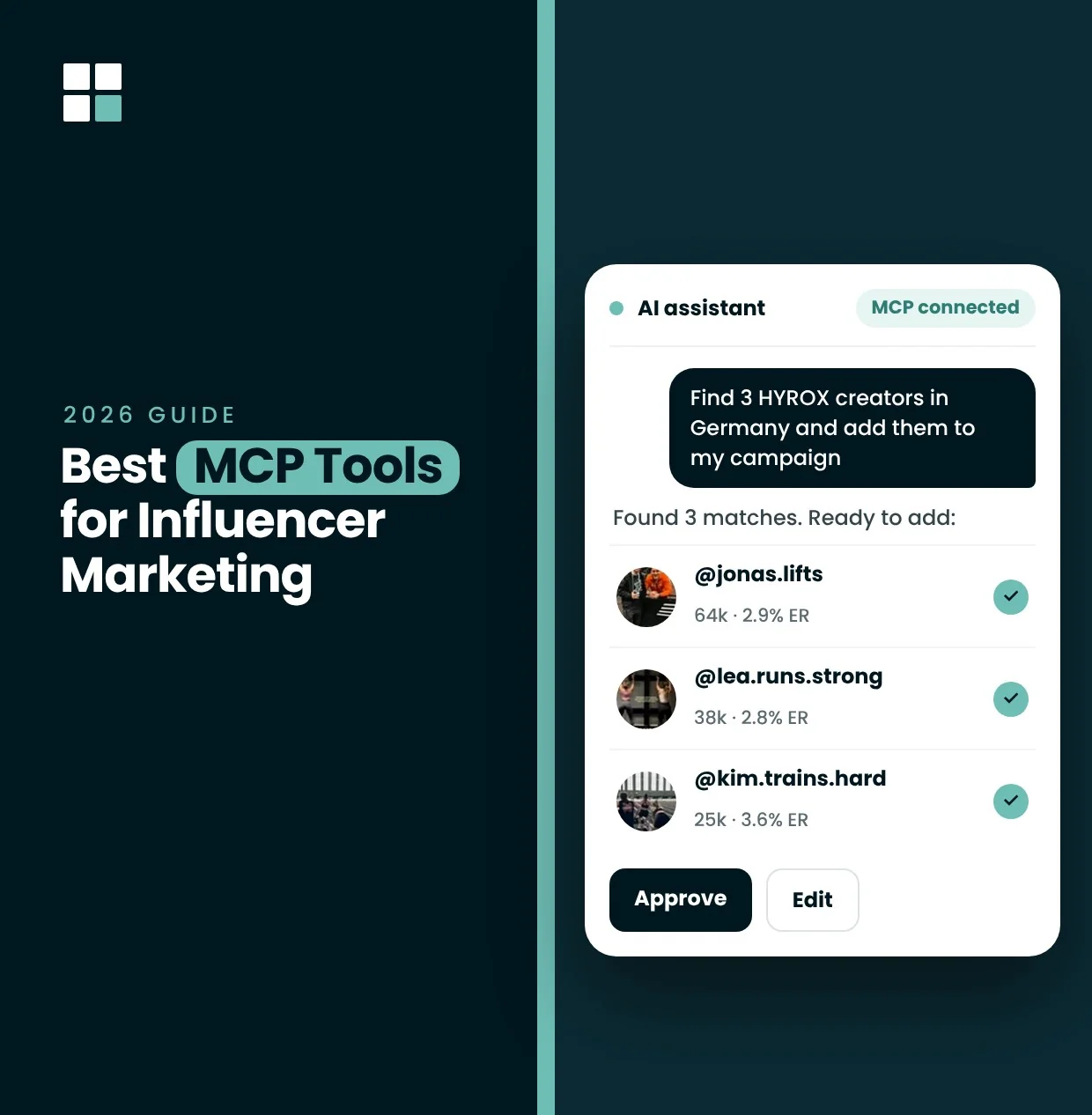
That changes when the assistant is connected to an influencer platform. With an MCP (Model Context Protocol) connector, the same chat can query a live creator database and return real profiles. We compared the options in our guide to the best MCP tools for influencer marketing.
<table style="width:100%; max-width:720px; border-collapse:collapse; font-family:Arial,Helvetica,sans-serif; font-size:15px; line-height:1.45; color:#000000; margin:24px 0;">
</table>
Most bad results come from vague prompts. "Find me fitness influencers" is a topic, not a brief. A good search prompt answers the same questions a good search filter does.
Use this formula:
Find [number] [platform] creators who post about [niche], with [follower range] followers, based in [creator location], with most of their audience in [audience location]. Exclude [what to skip]. Return [output format].
Bad prompt:
"Find fitness influencers for a German brand."
Good prompt:
"Find 30 Instagram creators who post home workouts and strength training, with 10K–80K followers, based in Germany, with at least 60% of their audience in Germany. Exclude creators who mainly post supplements or have worked with [competitor] in the last 6 months. Return handle, followers, engagement rate and email if available."
The second prompt works in any tool with real filters, and the same structure carries over to most influencer search tools. It also forces your team to settle the questions the client never answered in the brief.
These prompts don't need live creator data. They use AI for what it's good at: structuring, brainstorming and analyzing information you give it.
"Here's a client brief: [paste brief]. Turn it into influencer search criteria: platforms, niches, follower range, creator location, audience location, audience age and gender, content style, and red flags. Then list the 5 questions I should ask the client before searching."
Why it works: Briefs are often vague. This prompt shows you where they're vague before you spend time searching.
"List 30 words and phrases that [niche] creators in [country] actually use in their Instagram and TikTok bios and captions, in [language]. Group them into broad terms, niche terms and community slang."
Why it works: Creators rarely describe themselves the way brands do. A protein brand searches "fitness," while creators write "Hyrox," "gym girl," "calisthenics" or "mom of 3 who lifts." In local markets, ask for terms in the local language too.
"My client sells [product] to [target customer]. Besides the obvious [main niche] creators, suggest 8 adjacent creator niches whose audiences overlap with this customer. For each one, explain the overlap in one sentence."
Why it works: The obvious niche is usually the most expensive and crowded. A running shoe brand might do better with physiotherapists, dog walkers or commuter cyclists than with yet another running influencer.
"Which types of creators do [competitor 1] and [competitor 2] typically work with? Describe their content style, follower range and niches. Flag anything you're unsure about."
Why it works: It gives you a starting hypothesis. Treat the answer as a direction to check, not as facts. Confirm actual partnerships by looking at the creators' tagged posts or in your platform.
"Here are the last 12 captions and engagement numbers from @[handle]: [paste]. Rate how well this creator fits a brief for [brand/product] from 1 to 10. Explain the score, list any brand-safety concerns and suggest one collaboration idea."
Why it works: The AI isn't guessing here, because you've given it real data. It's a fast first-pass review before the human check.
"Create a checklist of signs that an Instagram or TikTok creator may have fake followers or engagement pods. For each sign, explain what to look for and what a normal range looks like."
Why it works: It gives junior team members a consistent vetting standard. It doesn't replace a proper audience authenticity report, but it helps catch obvious problems early.
This is where AI stops brainstorming and starts finding real people. The prompts below only work when your assistant is connected to an influencer platform. In our case that's Influencer Hero, through its MCP. Influencer Hero also offers the same kind of plain-language searching inside the app with its AI influencer search. There you describe a creator in your own words and it matches bios, posts and images across a database of 450M+ creators.
"Find 30 TikTok creators in the UK who post about meal prep, with 15K–100K followers. Show handle, followers, engagement rate and location."
"From that list, keep only creators with at least 50% of their audience in the UK."
Why it matters: A creator living in London can have a mostly US audience. For a client who ships only to the UK, audience location matters more than where the creator lives.
"@[handle] drove the most sales in last month's campaign. Find 15 lookalike creators with a similar niche, follower range and audience location."
Why it works: Your best performer is the most accurate brief you'll ever have. Starting from proven results beats starting from a guess.
"Find 40 Instagram creators in the Netherlands who post about sustainable fashion, 5K–30K followers, and only include creators with a contact email."
Why it works: A shortlist without contact details means another hour of DMing. Filtering for email upfront makes the list ready for outreach.
"Find creators who post about home coffee brewing on Instagram, TikTok and YouTube, 20K–150K followers, mostly US audience. Group the results by platform."
"Before pulling any audience reports, show me the shortlist. Then pull audience reports only for the 10 creators I select."
Why it matters: On most platforms, audience reports and contact lookups cost credits. On a busy week across several clients, asking for the list first saves a lot of credits you'd otherwise spend on creators you'd never pitch.
"Add the 10 approved creators to the [Client] Spring Launch campaign in the 'To Contact' stage. Show me the list before you add them."
Why it works: The shortlist goes straight into the campaign without exporting or copy-pasting. With Influencer Hero, actions like this need your approval before they run.
Different campaigns need different creators. These four templates are our starting points. Swap in your client's details. If you want to take these further than discovery, our guide to AI workflows agencies can run with MCPcovers outreach, seeding and reporting. [[CONFIRM URL ONCE THE MCP ARTICLE IS LIVE]]
"Find 50 Instagram and TikTok creators with 5K–50K followers who post about [niche] in [country], with high engagement and no paid partnerships in the last 3 months. We're sending free product with no payment, so prioritize creators who regularly post gifted content."
"Find creators in [niche] who regularly share discount codes or affiliate links and get high comment engagement. 10K–200K followers, [country] audience. Show any past brand collaborations."
"Find creators who make clean, product-focused short-form videos for [product category]: unboxings, tutorials and before/after content. Follower count doesn't matter. Prioritize content quality and a consistent posting schedule."
"My client is launching [product] in [new country]. Find 25 local creators in [niche] who post in [language], 10K–100K followers, with at least 60% of their audience in [country]."
These are the mistakes we see most often:
Once your shortlist is clean, the next step is reaching out. We compare the tools for that in our guide to the best influencer outreach tools.
The first six prompts work in any AI assistant. Prompts 7–17 need a tool with real creator data. Here's how the main options compare, based on each vendor's own pages and public reviews as of November 2026:
<table style="width:100%; max-width:720px; border-collapse:collapse; font-family:Arial,Helvetica,sans-serif; font-size:15px; line-height:1.45; color:#000000; margin:24px 0;">
</table>
Our take: If you only need a shortlist now and then, a data-only connector like Influencers.club does the job inside ChatGPT. If you run campaigns for clients, you'll want the search connected to the place where outreach, seeding and payouts happen, so the shortlist doesn't end up stuck in a spreadsheet. That's why we run discovery through Influencer Hero.
One limit to know: Influencer Hero's newest search methods (AI Profile Search, Visual Search, Lookalike Search and Deep Research) are live for Instagram first, with TikTok and YouTube listed as coming soon. For a broader look at standalone platforms, see our roundup of the best influencer discovery tools.
The best AI prompts to find influencers are specific, and they're run in the right place. Use ChatGPT or Claude on their own to sharpen the brief, generate keywords and vet creators you've already found. Use AI connected to a creator database for the actual search.
Start with the formula, save the prompts that work for your clients, and keep a human in the loop before anyone gets an email.
Prefer to have an agency handle discovery for you? That's what we do at NC Media.
FAQ