Table Of Content
h1,h2
Compare Influencer Hero vs Upfluence from an agency lens at NC Media—covering influencer discovery, CRM, pricing, scalability, ROI tracking, and why Influencer Hero is the better alternative for agencies managing multi-client campaigns.



Table Of Content
When you work closely with brands on influencer marketing, you start to notice patterns pretty quickly. Certain platforms are great for very specific use cases, while others struggle once campaigns move beyond a single market, a single channel, or a single campaign type. Tools like Upfluence are often part of the conversation—especially for eCommerce brands—but from an agency point of view, there are clear gaps that tend to surface as programs scale.
Across multi-brand, multi-market influencer campaigns, what usually matters most isn’t just finding creators. It’s being able to manage outreach at volume, switch easily between gifting, affiliate, and paid collaborations, and report on performance in a way that actually ties back to ROI. That’s where Influencer Hero starts to differentiate itself. Its CRM-led workflows, automation depth, and campaign flexibility align far more closely with how agencies operate day to day.
In this comparison, we’ll explain why Influencer Hero stands out as a stronger Upfluence alternative and why it’s increasingly viewed as one of the best influencer marketing software options for agencies and performance-driven teams managing influencer programs at scale.
At NC Media, we manage influencer programs that range from brand awareness initiatives to performance-led campaigns. In projects like our work with Beau Bottles, where influencer marketing contributed directly to measurable sales growth, operational flexibility and clear ROI tracking become essential when running campaigns at scale.
That naturally means managing several brands at once, often with very different goals, timelines, and creator strategies running in parallel. Some clients focus heavily on product seeding, others prioritize affiliate-driven sales, while many combine gifting, paid collaborations, and UGC for ads within the same quarter.
From an agency perspective, this means relying on tools that let us switch easily between campaign types, move fast across markets, and keep full visibility across large volumes of creators without losing context. Managing outreach, deliverables, usage rights, and performance for multiple clients is the baseline, while flexibility across different eCommerce setups and clear client reporting are essential. This focus on operational efficiency—rather than just feature depth—is what frames our comparison between Influencer Hero and Upfluence throughout this article.
Here’s a side-by-side snapshot of how Influencer Hero and Upfluence compare on key factors that matter most to agencies running influencer programs:
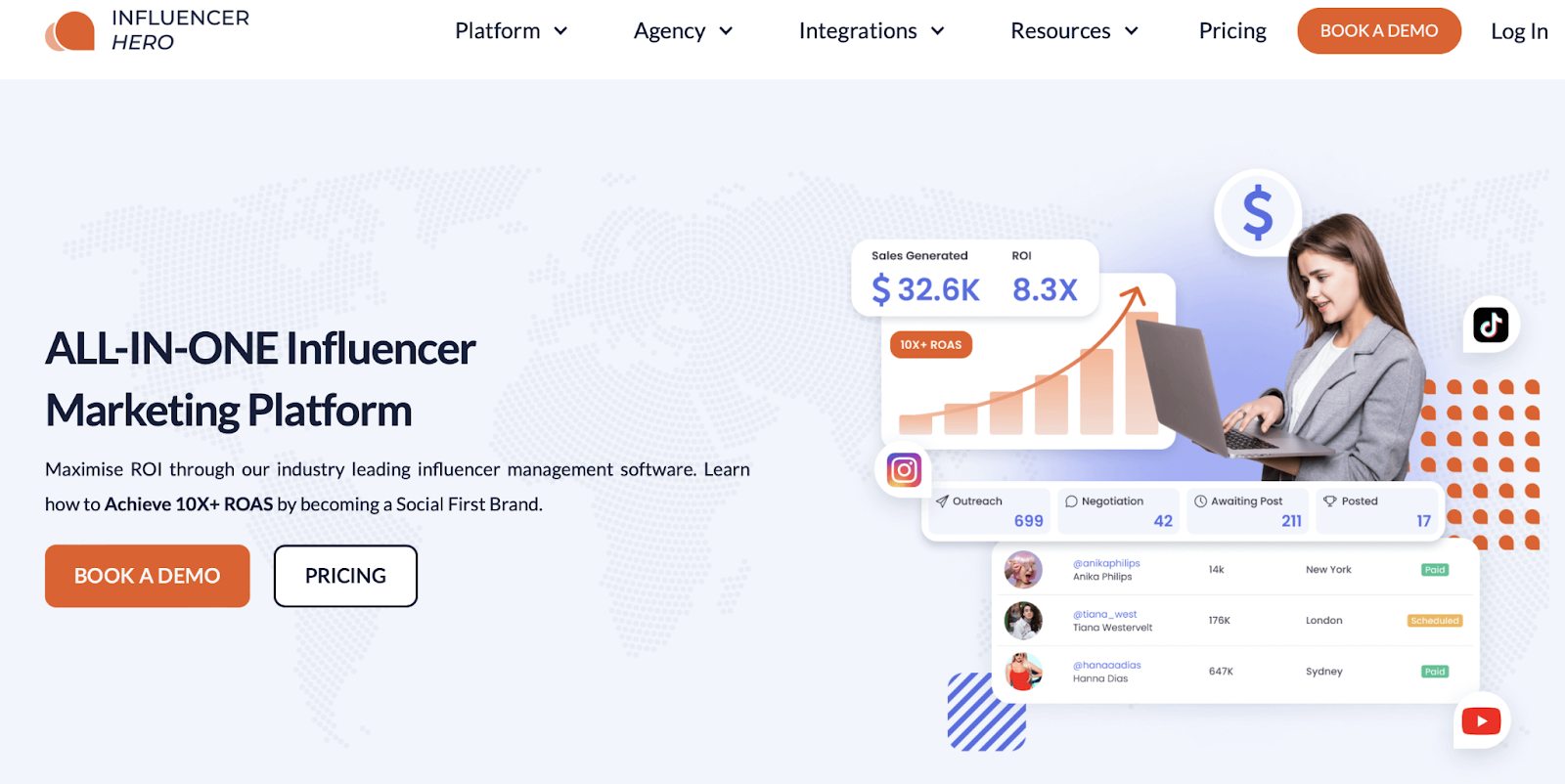
Influencer Hero is one of the best influencer marketing sofwaters, built around a CRM-first approach, which helps agencies orchestrate campaigns across dozens of clients without losing track of relationships. Its discovery tools span a massive creator database with AI-powered recommendations, while its outreach, automation, and performance reporting support everything from gifting to affiliate and paid UGC workflows.
For agencies juggling multi-market programs, the platform’s flexibility and operational efficiency stand out, especially when managing creator pipelines, follow-ups, and ROI tracking at scale.
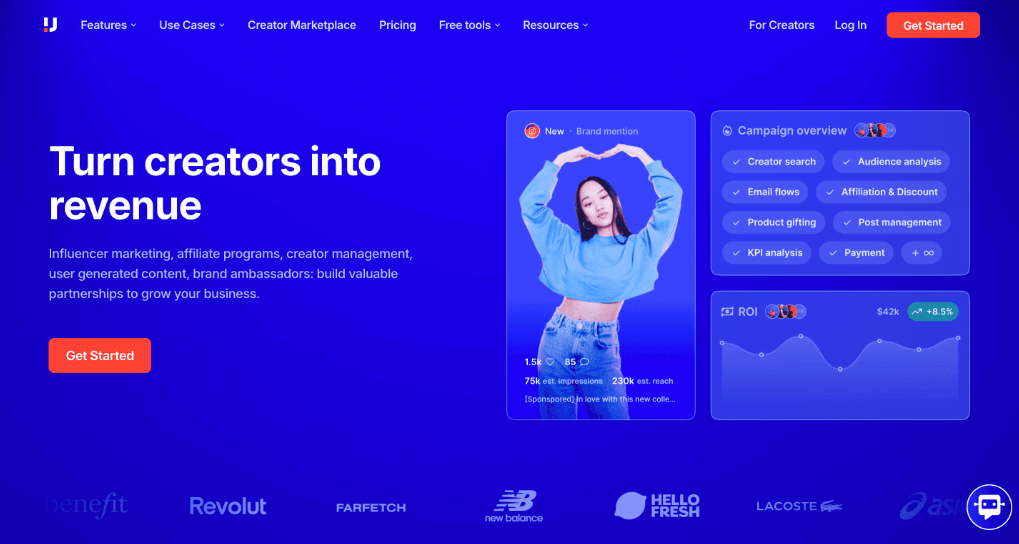
Upfluence offers robust creator discovery with a database enriched for eCommerce signals—especially useful for brands focused on Shopify and Amazon storefronts. It includes in-platform outreach and an AI assistant to help personalize messages.
Attribution for tracked sales and engagement is a strong suit, particularly for direct-to-consumer brands centered on purchase performance. While Upfluence is powerful, its workflows can feel more rigid once campaigns expand beyond single campaign types or require agency-level orchestration across multiple clients.
Upfluence offers a solid discovery experience centered around a curated database of 12M+ global creators. Its filters cover the fundamentals agencies expect—location, niche, follower size, engagement rate, audience demographics, and even suggested pricing. However, discovery is largely confined to what already exists inside the database, which can limit flexibility when sourcing creators in emerging niches or scaling volume quickly.
Influencer Hero approaches discovery from a broader, more dynamic angle. Beyond a significantly larger creator pool, it combines advanced filters, lookalike creator suggestions, fake follower detection, brand-follower identification, and AI-assisted recommendations. This makes Influencer Hero better suited for agencies that need speed, depth, and adaptability across multiple markets and verticals.
Upfluence includes built-in outreach with bulk email sending, automated drip sequences, and AI assistance through its campaign assistant. Communication and performance tracking live in the same environment, which helps reduce tool switching. That said, its CRM functionality is primarily campaign-centric, meaning it works best when campaigns follow a linear structure and don’t require heavy relationship orchestration over time.
Influencer Hero is clearly designed with a CRM-first mindset. Outreach, follow-ups, approvals, and reminders are automated through structured workflows that scale easily from dozens to thousands of creators. Relationship boards visually track each creator’s stage, deliverables, and status, which is especially valuable when managing multiple brands at once.
For agencies, this difference matters: Influencer Hero feels built to orchestrate ongoing creator relationships, not just execute isolated campaigns—making it the stronger option for complex, multi-client environments.
Upfluence performs well when attribution is tightly connected to Shopify or Amazon. Within campaigns, agencies can track sales, conversions, clicks, reach, impressions, engagement, and individual influencer performance. This makes it appealing for brands that prioritize direct purchase attribution within a single commerce ecosystem, yet there are platforms with better affiliate features.
Influencer Hero offers a more flexible, agency-friendly view of performance. In addition to engagement metrics, it tracks affiliate sales, clicks, ROI per influencer, UGC usage, and content performance across platforms. Reports are built to be exported and shared directly with clients, reducing manual work.
For agencies that need to report across affiliate, gifting, paid collaborations, and UGC usage—not just Shopify sales—Influencer Hero delivers clearer, more comprehensive ROI visibility.
Upfluence is strongest when campaigns follow a defined path: product gifting, affiliate programs, or customer-to-creator advocacy—particularly for Shopify and Amazon sellers. While it supports these use cases well, running mixed strategies in parallel can require additional setup and coordination.
Influencer Hero is built to support multiple campaign types simultaneously. Gifting and product seeding, affiliate links and discount codes, paid collaborations, UGC collection for ads, and storefront-driven sales all live inside the same workflow.
This flexibility is critical for agencies managing clients with different goals and evolving strategies, and it’s a key reason Influencer Hero stands out as the more adaptable Upfluence alternative.
Upfluence’s pricing, based on the demo, is set at $1,276 per month with an annual commitment. While there are no limits on the number of influencers you can work with and no commission fees, the required yearly contract and higher entry cost can be restrictive for agencies managing clients with seasonal campaigns or fluctuating volumes. Even with the option to remove certain modules to reduce cost, the structure assumes a relatively fixed, long-term usage model.
At NC Media, we believe pricing should support how agencies actually operate. Influencer Hero’s tiered pricing with monthly flexibility—starting at $649 per month for up to 1,000 creators, scaling to $1,049 for 5,000 creators and $2,490 for 10,000 creators, with custom agency plans available—makes it far easier to scale capacity up or down as client needs change.
From an agency cash-flow and risk perspective, this flexibility makes Influencer Hero a more practical and agency-friendly alternative.
Upfluence is a powerful platform, but that power often comes with a steeper learning curve—especially for junior team members or non-technical users. Getting the most out of the tool typically requires onboarding time and process alignment.
Influencer Hero emphasizes speed and clarity. The interface is clean, workflows are intuitive, and teams can be up and running quickly without extensive training. For agencies onboarding new hires or rotating team members across accounts, this ease of use reduces friction and helps campaigns launch faster.
Upfluence provides standard support and platform assistance, which works well for troubleshooting and general guidance. However, support is largely reactive and product-focused.
Influencer Hero positions support as part of the overall partnership. They provide dedicated account managers, onboarding sessions, fast live chat and email support, and an in-platform help desk with detailed guides.
For agencies, this level of support goes beyond issue resolution—it helps teams optimize workflows, scale campaigns, and adapt strategies over time, reinforcing Influencer Hero’s position as the stronger long-term partner.
When you step back and look at how influencer marketing is actually executed at an agency level, the differences between Influencer Hero and Upfluence become clear. Upfluence is a capable platform, particularly for Shopify- and Amazon-focused brands running structured, commerce-led programs. However, for agencies managing multiple clients, markets, and campaign types at the same time, its rigidity, annual commitments, and campaign-centric workflows can create friction as programs scale.
Influencer Hero is better aligned with how agencies operate day to day. Its CRM-first approach, flexible campaign structures, scalable outreach automation, and clearer pricing tiers make it easier to manage large volumes of creators without losing control or context. Combined with broader discovery capabilities, stronger multi-campaign reporting, and monthly scalability, Influencer Hero consistently stands out as the more adaptable and agency-friendly alternative to Upfluence.
At NC Media, we believe the right platform is only part of the equation—the real impact comes from how it’s implemented. If you want to see how an agency-led influencer strategy can be structured for your brand, book a demo with the NC Media team to walk through real campaign setups, workflows, and performance frameworks tailored to your goals.
FAQ

For agencies managing multiple brands, markets, and campaign types, Influencer Hero tends to be the stronger option. Its CRM-first workflows, flexible pricing tiers, and support for gifting, affiliate, paid, and UGC campaigns in one platform make it easier to scale programs without operational friction. Upfluence works well for specific eCommerce use cases but can feel more rigid at agency scale.
Influencer Hero is better suited for multi-client management because it was built to handle large creator volumes, automated outreach, and relationship tracking across multiple campaigns at once. Agencies benefit from clear visibility, flexible workflows, and reporting that can be adapted per client, rather than campaign-by-campaign limitations.
Yes. Influencer Hero supports product seeding, affiliate links, discount codes, paid collaborations, and UGC collection within the same platform. This flexibility allows agencies to run hybrid influencer strategies without switching tools or building workarounds.
Upfluence can be a good fit for Shopify- or Amazon-focused brands that prioritize direct sales attribution and customer-to-creator programs. For single-brand setups with predictable campaign structures, its eCommerce integrations can be effective. However, agencies often outgrow its flexibility as campaign complexity increases.
Most agencies base the decision on scalability, pricing flexibility, and workflow efficiency. Influencer Hero’s monthly pricing options, CRM-led approach, and broader campaign support make it easier to adapt as client needs change, which is why many agencies view it as a more future-proof Upfluence alternative.








.png)