Table Of Content
h1, h2
Phyllo pricing in 2026 is custom and quote-based (≈$199/mo per third parties). See what Phyllo actually does, reviews, alternatives, and a done-for-you agency option.


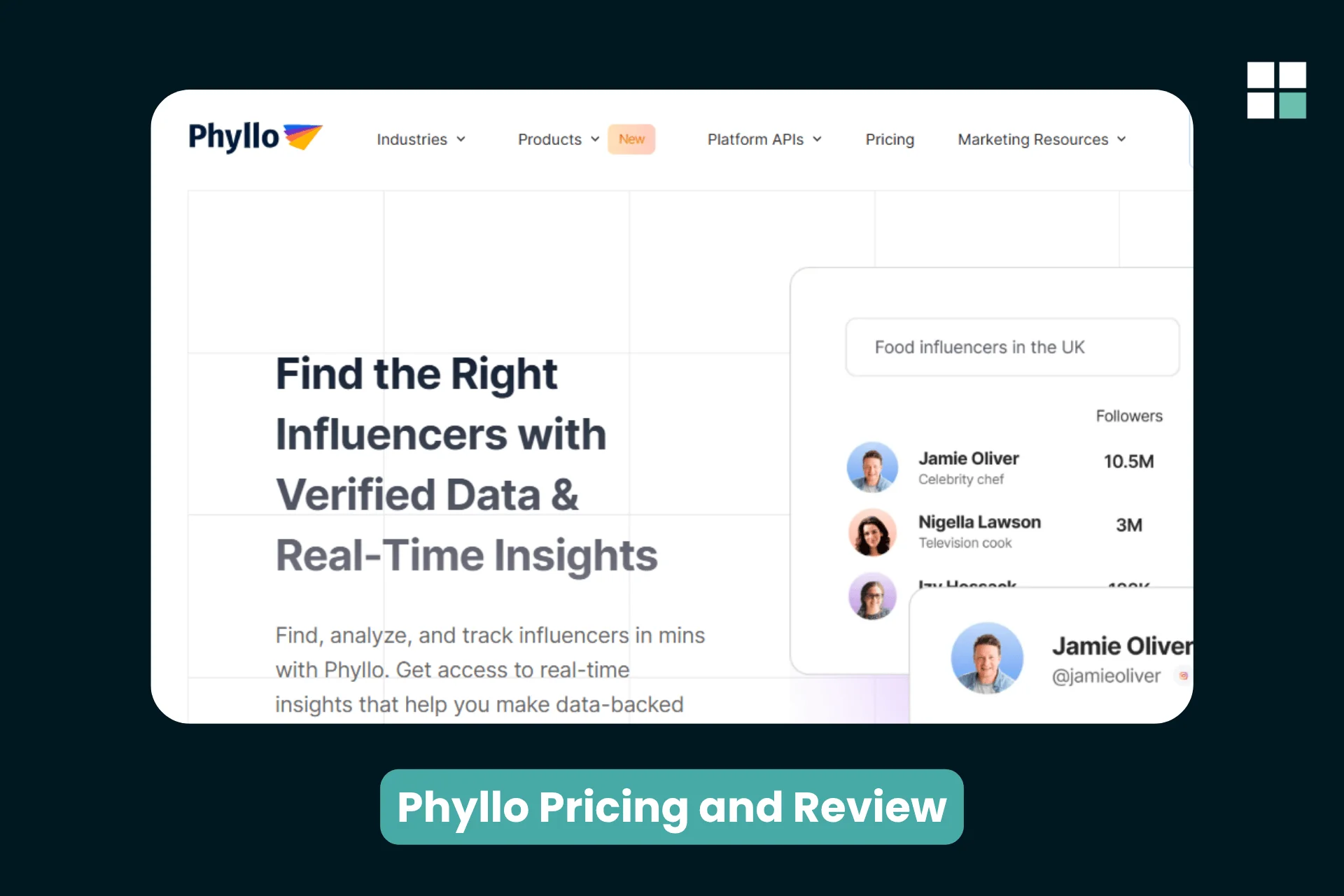
Table Of Content
Phyllo pricing is fully quote-based — there are no published plans or tiers. You request a custom quote based on which APIs you need and how much data you pull, and third-party sources peg the entry point at roughly $199/month, though Phyllo doesn't confirm that publicly.
Here's the more important thing to know before you go any further: Phyllo isn't an influencer marketing platform. It's developer infrastructure — a set of APIs that engineers build creator-economy products on top of.
If you found Phyllo while researching how to run influencer marketing, that distinction will save you a lot of time. Below is what Phyllo actually costs, what it does, and a done-for-you alternative if building software was never the goal.
Phyllo doesn't publish pricing tiers. The pricing page is a single "Get a Quote" button, and your cost depends on which APIs you use, the platforms you need, and your data volume.
A few things worth knowing about how it's priced:
You won't get a number without a conversation. Third-party directories cite a starting point around $199/month for entry-level API access, but treat that as an unconfirmed signal, not a guarantee — Phyllo's own materials don't list it.
Developers can sign up for a free dashboard to test integrations before committing, which is normal for API products. It's for building, not for running campaigns.
Because pricing follows API calls and data volume, your real monthly spend moves with usage. One G2 reviewer flagged that the custom, API-based pricing is confusing and hard to track without a usage dashboard.
The honest summary: if you need a fixed, predictable number to budget against today, Phyllo won't give you one without a sales call.
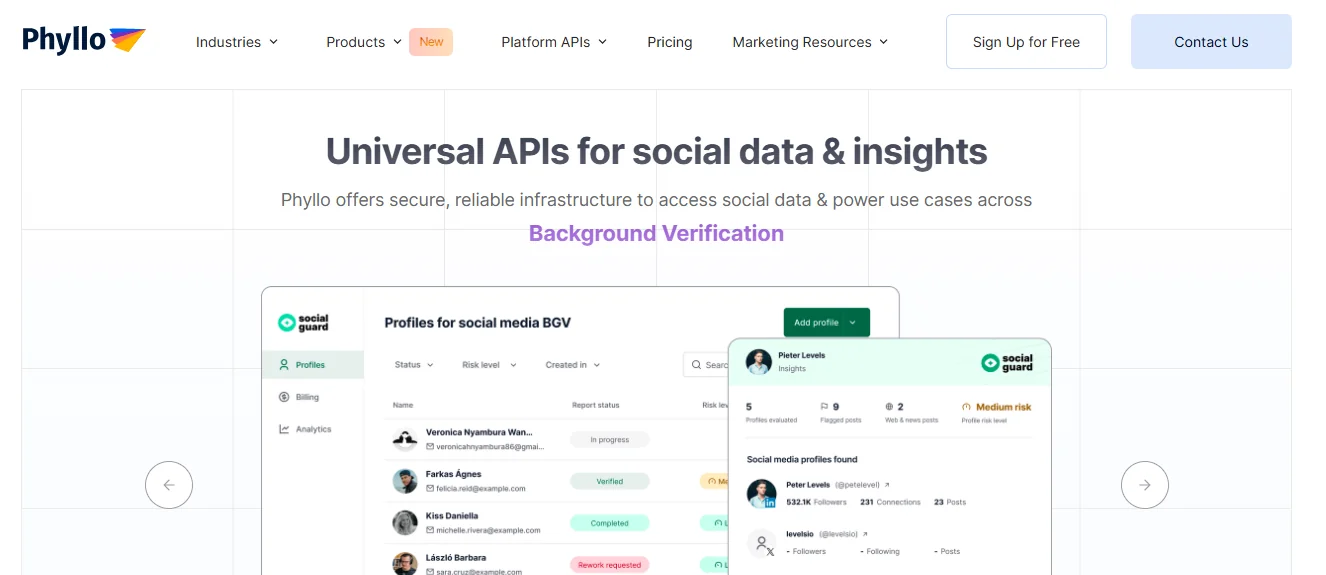
Phyllo is an API-first creator data infrastructure company. It connects to 20+ social platforms — Instagram, YouTube, TikTok, Twitch, Snapchat, LinkedIn and more — and delivers normalized, consented creator data through a single API so companies don't have to integrate each platform themselves.
It's built for product and engineering teams, not marketers. The typical Phyllo customer is a company building something in the creator economy: a creator tool, an influencer platform, a fintech doing creator income verification, or a background-screening product. Phyllo handles the data plumbing so those teams can focus on their own product.
That's the key point for a brand. Phyllo gives you raw, authenticated data via API — it has no campaign management, no outreach, no CRM, and no ready-to-use dashboards. It's a layer you build on, not a product you run campaigns in.
Phyllo is well-regarded by the developers who actually use it. On G2, reviewers consistently praise getting cross-platform creator data from a single API, the real-time data feeds and webhooks, and a support team that's responsive and helpful. The recurring theme is that it saves engineering teams from building and maintaining painful platform-by-platform integrations.
The complaints are just as consistent, and they matter. The authentication requirement creates friction — one reviewer noted the YouTube permissions are daunting enough that they scared off some of their own users. Others flag confusing usage-based pricing with no easy way to see usage stats, and occasional downtime or integration maintenance.
The pattern is clear: developers building creator products like Phyllo; teams expecting a finished, usable tool are looking at the wrong product. That's worth holding onto for the comparison below.
Most software-vs-agency comparisons weigh a tool that runs your campaigns against an agency that runs them for you. With Phyllo, the gap is even wider — Phyllo isn't a finished tool at all. It's raw infrastructure that requires a development team to turn into anything usable.
So the real question isn't "Phyllo or an agency." It's "do you want to build software, or do you want results." NC Media runs your entire influencer program and is accountable for the outcomes.
When the software wins. If you're a company building a creator-economy product — and you have the engineers to do it — Phyllo is a strong choice. It genuinely removes the headache of integrating 20+ platforms yourself, and the developer experience is a real strength. For that buyer, Phyllo is doing exactly what it's designed to do.
When NC Media wins. If you're a brand that wants to run influencer marketing and grow sales, Phyllo solves a problem you don't have. You'd need to hire developers, build dashboards, wire up outreach, and design a campaign system before you ran a single collaboration. NC Media skips all of that — across 8 years we've driven an 8X+ average ROAS increase and a -52% average CAC reduction for brands like Lululemon, Decathlon, Nespresso, and Under Armour, producing 120K+ UGC assets and 50K+ influencer partnerships.
The hidden cost of software. With a tool like Phyllo, the API fee is the smallest line item. The real cost is the engineering time to build on it, plus the marketing team to actually run campaigns once it's built. For a brand, that's a product investment and a staffing problem before it's ever a marketing channel — which is exactly the work an agency absorbs for you.
For the right buyer, absolutely. If you're building a creator tool, an influencer platform, or a fintech product that needs creator data, Phyllo is a credible, well-supported way to get consented, cross-platform data without integrating every network yourself. The developer experience and breadth of platform coverage are real advantages.
Where it's the wrong call is for brands and marketing teams. Phyllo gives you data and pipes, not campaigns or results, and the authentication friction plus quote-gated pricing add overhead a marketer doesn't want. If your goal is to run influencer marketing rather than build software, Phyllo isn't a fit — and that's not a flaw in the product, just a mismatch in what you need.
If you've decided software is your route, the right alternative depends on whether you want a finished product or another data layer. The first pick gives you a complete application instead of raw API; the other two are genuine data-API competitors to Phyllo.
• All-in-one influencer marketing platform for D2C brands and agencies
• Starts at $649/month (Standard), with Pro at $1,049 and Business at $2,490
• The finished product Phyllo would require you to build — discovery, outreach, CRM, gifting, affiliate, payments, and UGC in one place
Influencer Hero is the right pick if you wanted Phyllo's creator data but never actually wanted to build software around it. Instead of raw APIs, you get a working platform: find creators, run AI-personalized outreach, manage relationships, track affiliate sales, and process payments without a single line of code. It's a higher sticker price than an entry API plan, but you're buying a complete program, not infrastructure to assemble.
• Creator discovery platform with both a usable UI and a transparent-priced API
• Plans start around $199/month (Essential), $499/month (Performance), enterprise custom
• Indexes 350M+ public profiles, so there's no creator-authentication friction
Unlike Phyllo, which waits for a creator to log in, Modash proactively indexes the public social web — so you can search and analyze creators who've never touched your app. It also publishes its API pricing openly, which solves one of Phyllo's most common complaints.
• Influencer analytics platform with an API suite, focused on audience validation and fraud detection
• Starts around $299/month (annual) for Basic, $499/month for Pro; enterprise custom
• Strong if your data need is creator authenticity and audience quality
HypeAuditor offers both a usable platform and API access to its analytics, making it a fit if your priority is vetting creators rather than building infrastructure. Its core strength is fraud detection and audience-quality scoring, so it's a credible alternative when data accuracy is the point. Note that pricing is sales-led above the base tier.
And if building or managing any of this yourself sounds like more than you want to take on, that's exactly where a full-service agency comes in — more on that below.
Phyllo is a solid piece of infrastructure for the job it's built for: giving product teams consented, cross-platform creator data through a single API. The pricing is quote-based and usage-driven, the developer experience is strong, and the platform coverage is broad. For a company building a creator-economy product, it's a real time-saver.
But it's infrastructure, not a marketing solution. For a brand that wants influencer marketing to function as a measurable growth channel — without hiring engineers, building dashboards, and staffing a campaign team — the better-fit model is an agency that owns the outcome end to end.
If you're evaluating Phyllo and wondering whether a full-service agency might be a better fit, NC Media offers a no-commitment consultation. Book a call here.
FAQ








.png)