Table Of Content
h1, h2
MOGL pricing in 2026: plans start at $0/month plus a 50% service fee, scaling to $250/month. See full costs, reviews, and the full-service agency alternative.


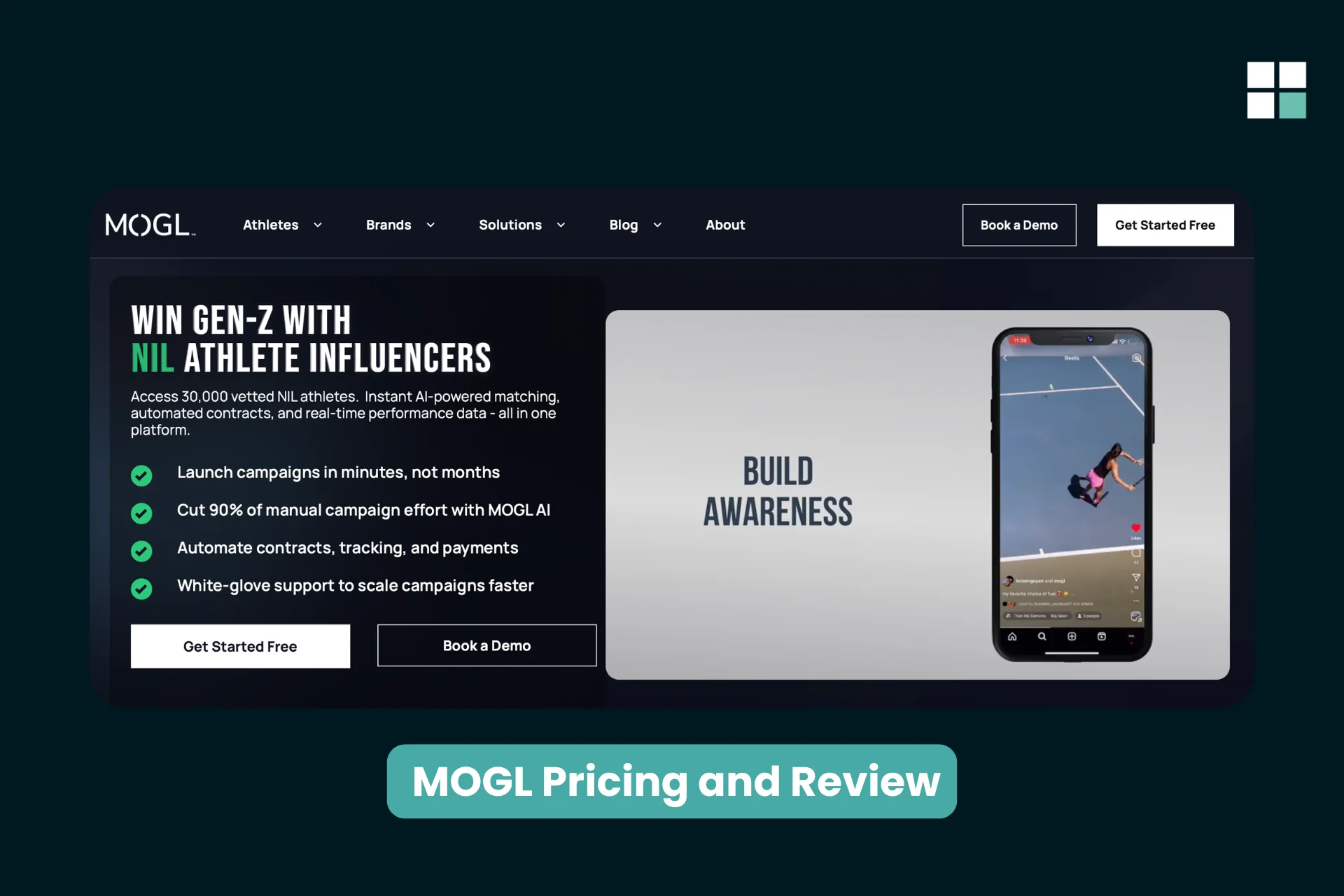
Table Of Content
MOGL pricing starts at $0/month with a 50% service fee, climbs to $250/month with a 20% service fee on its Professional plan, and goes custom for its fully managed Elite tier. So the sticker price is low, but the service fee is where the real cost lives.
MOGL is a niche player. It's built specifically for athlete influencer marketing in the NIL (Name, Image, and Likeness) era, connecting brands with US college and pro athletes.
If you're weighing MOGL, it's worth knowing there's a different route entirely: handing the whole thing to a full-service agency instead of running campaigns yourself. More on that below - first, the pricing.
MOGL runs on three tiers. The twist is that the monthly fee is only half the story - every plan layers a service fee on top of what you pay athletes.
• $0/month
• 50% service fee on athlete payments
• Hire one athlete at a time
• Chat support, no product gifting
The free entry point looks great until you notice the 50% service fee. If you pay an athlete $1,000, MOGL takes $500 on top. It's fine for testing a single deal, but the math gets ugly fast at any real volume.
• $250/month
• 20% service fee on athlete payments
• Hire multiple athletes
• Product gifting as compensation, enhanced support
This is MOGL's "most popular" tier and the one most active brands land on. The flat $250 plus a lower 20% fee makes scaling more reasonable, and you unlock multi-athlete campaigns and gifting. It's the sweet spot for brands running ongoing NIL activations in-house.
• Custom pricing (you have to talk to sales)
• Full campaign management and content production
• Dedicated customer success manager
• Customized to your brand
Elite is where MOGL stops being software and becomes a managed service. Pricing isn't published, so you're into a sales conversation. This is MOGL acting as an agency — but only within its college-athlete lane.

Statusphere is a micro-influencer marketing platform built for consumer brands that want guaranteed, rights-ready UGC at scale. It automates the operational grind of creator campaigns - sourcing, product seeding, fulfillment, content rights, and reporting - using AI to match creators to brands and run logistics in the background. The company has raised $27 million to date and positions itself toward enterprise and mid-market consumer brands.
MOGL is an AI-powered platform and agency built exclusively for athlete influencer marketing. Founded in 2019 by former Notre Dame quarterback Brandon Wimbush and CEO Ayden Syal, it connects brands with a network of 30,000+ college and pro athletes and handles the NIL-specific headaches like NCAA compliance and disclosures. It operates a bit like an Indeed for athletes: brands post campaigns, athletes apply, and payment releases after proof of post.
MOGL is newer and niche, so public review volume on G2 and Capterra is thin compared to mainstream influencer platforms. Take the sentiment below as directional rather than a large sample.
Users consistently describe the platform as intuitive and easy to learn, with the job-board setup and automated messaging singled out as strengths. Support also gets praise — one recurring note is that chat support is responsive and onboarding is quick.
The flags are about scope, not usability. Reviewers and comparison sites point out that gifting logistics and external integrations feel underbuilt, analytics mostly show impressions without deeper breakdowns, and deal quality can vary. A common forum take is that campaign setup can still take weeks despite the AI, and the US-college-athlete-only focus is limiting if your audience isn't Gen Z sports fans.
Here's the real decision. MOGL gives you the infrastructure to run athlete campaigns yourself — and on its self-serve tiers, you're the one doing the work. NC Media is a full-service agency that runs influencer campaigns end to end and is accountable for the results.
When the software wins. If your audience is squarely Gen Z sports fans and you have someone in-house to run NIL campaigns, MOGL is a smart, purpose-built tool. The compliance automation alone is worth it if athlete marketing is your channel. No argument there.
When NC Media wins. If you don't have a dedicated influencer hire, want results across more than just college athletes, or have tried managing software and found the lift too high, an agency fits better. NC Media brings 8 years of experience, 50K+ influencer partnerships, and 120K+ UGC assets produced — with an average 8X+ ROAS increase and -52% CAC reduction for clients like Lululemon, Decathlon, Nespresso, and Under Armour.
The hidden cost of software. That $250/month is not the real cost. Someone on your team still writes the briefs, vets the matches, approves content, and tracks performance — and MOGL's 20–50% service fee stacks on top of every athlete payment. Once you price in staff time plus those fees, the gap between "cheap software" and a managed agency narrows a lot more than the sticker suggests.
For brands targeting college athletes specifically, MOGL is one of the few tools purpose-built for the job. The NIL compliance, athlete network, and proof-of-post payments solve problems generic influencer software ignores. If that's your exact use case and you have in-house bandwidth, it's worth it.
It falls short when your needs are broader. The college-athlete-only focus, thin analytics, and service-fee model make it a poor fit for brands wanting cross-platform reach, UGC at scale, or someone else to simply own the results. At that point you're either adopting a broader tool or hiring an agency.
If MOGL's niche focus or service-fee pricing isn't the right fit, these tools cover similar ground with broader reach. All three handle discovery, outreach, and campaign management across Instagram, TikTok, and YouTube - not just college athletes.
Influencer Hero is the strongest all-rounder here. Where MOGL locks you into athletes and stacks service fees on top, IH gives you a global, cross-platform creator database and bundles the entire workflow into a flat plan. The Shopify and WooCommerce integrations plus AI-personalized outreach make it a better fit for brands that want scale without the niche.
Aspire suits brands that want to build a creator community rather than run one-off deals. It's heavier on UGC and ambassador workflows than MOGL, and it isn't boxed into a single athlete niche.
Upfluence is the pick when discovery is the priority, its database and search filters go far beyond a single category. It also plugs into your e-commerce stack to pull in your own customers as potential creators.
And if managing any of these tools yourself sounds like more than you want to take on, that's exactly where a full-service agency comes in, more on that below.
MOGL is a sharp tool for a specific job: NIL and college-athlete campaigns, with compliance and payments handled. Just go in clear-eyed - the $0 and $250 plans still put the work on your team, and the 20–50% service fee means the real spend is well above the monthly fee.
If you'd rather influencer marketing function as a measurable growth channel without building an in-house operation, an agency is the better lever. NC Media runs campaigns across the full influencer landscape and is accountable for ROAS and CAC, not just access to creators.
If you're evaluating MOGL and wondering whether a full-service agency might be a better fit, NC Media offers a no-commitment consultation.
FAQ



.png)